The lid decides which kind of cooking is happening
Most people treat a lid as a way to make things cook quicker, and reach for it when they are impatient. It is really a switch between two entirely different processes, and choosing the wrong one is behind a surprising share of dishes that come out tasting flat or looking pale when they should be dark.
Covered, the food is being cooked by water. Uncovered, past a certain point, it is being cooked by dry heat. Those produce different flavours, not merely different speeds, and no amount of extra time in the wrong mode will get you to the other one.
Why a covered pan cannot go above boiling point
While there is liquid water in a pan, the contents cannot get much above 100°C at ordinary pressure. Every extra joule of heat you supply goes into turning water into steam rather than raising the temperature, because evaporation absorbs an enormous amount of energy. The pan sits there, stubbornly, at the temperature of boiling water.
A lid makes that ceiling worse rather than better. Steam rising from the food hits the cool underside of the lid, condenses, and drips straight back in. The moisture that would otherwise have left the pan is being recycled, so the surface of the food stays wet and the wet surface stays at boiling point.
That is precisely the condition under which browning cannot occur. The reactions that generate roasted, savoury, complicated flavours need surface temperatures well above the boiling point of water, and they simply do not proceed on a wet surface. This is why a covered onion goes translucent and sweet but never golden, however long you leave it.
When holding at boiling point is exactly what you want
Half of Indian cooking wants that ceiling. A dal that needs to sit at a steady simmer for forty minutes without drying out, a vegetable being cooked in the water it releases, a pulao where the rice must absorb a measured quantity of liquid and nothing may escape — in all of these, evaporation is the enemy and the lid is the tool.
A lid also makes the heat inside a pan far more even. Steam fills the space, wraps around the food from every side, and reaches surfaces that a hot metal base never touches. Anything that would otherwise cook from the bottom only, such as a thick piece of vegetable in a shallow pan, benefits enormously.
And it keeps volatile aromatic compounds in the pan instead of in the room. A dish finished under a lid off the heat for a few minutes smells noticeably stronger when it is uncovered, because everything that would have drifted away has been condensed and returned.
The mistakes come from switching too late or not at all
The classic failure is browning an onion base under a lid to speed it up. The onion softens, releases its water, and then sits in that water at boiling point, going nowhere. Cooks then blame the recipe, or the spices, when what actually happened is that the browning step never took place at all.
The mirror image is a curry left uncovered through a long simmer, reducing far past the consistency intended, so the spices concentrate and the whole thing turns harsh and salty. Reduction is a legitimate technique, but it should be a decision rather than an accident of having no lid to hand.
The useful habit is to think of the lid as something you move at least once during cooking. On to soften and to get water out of the vegetables, off to let that water go and let the surface get hot enough to brown, back on to finish gently. A lid left ajar splits the difference, letting some steam escape while keeping the pan warm and even.
A pressure cooker is the same idea, pushed
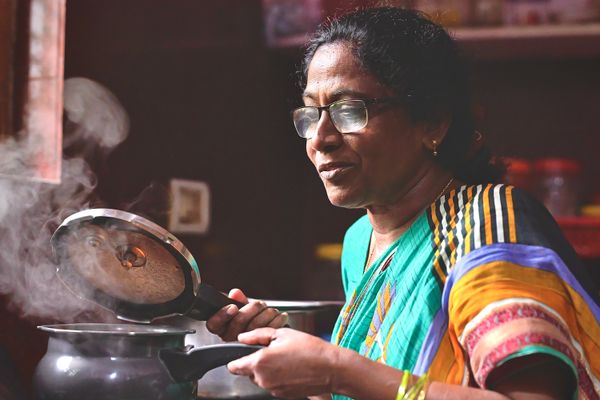
A pressure cooker is worth understanding in this frame, because it is a lid taken to its logical end. By sealing the pan completely, it lets pressure build, and under higher pressure water boils at a higher temperature — comfortably above 110°C rather than at 100°C.
That temperature is what makes the difference, not the seal itself. Reaction rates climb steeply with temperature, so a pulse that would take an hour in an open pot can be done in a fraction of that. But you have also guaranteed a wet environment, so nothing inside a pressure cooker will ever brown, which is why almost every pressure-cooker recipe browns its base first and seals afterwards.
Common questions
Should the lid go on before or after the water boils?
For anything you want to reach a simmer quickly, lid on from the start — it stops heat leaving with the steam. Once you are at a steady simmer, the lid is only controlling evaporation, so its position depends on how thick you want the finished dish.
Why does my rice go sticky under a tight lid?
A sealed pot returns every drop of condensed water to the rice, so the grains end up with more liquid than the recipe assumed. A cloth under the lid, or a lid left very slightly ajar for the last few minutes, absorbs or vents the excess.
Does covering a pan really save fuel?
Yes, quite substantially, because most of the heat leaving an open pan leaves as steam. That is a genuine reason to cover things during the long, dull middle of a simmer, and it costs you nothing as long as the browning has already happened.
Reporter, Wah Taste
Gautam covers everyday cooking, street food, spice & pantry and the questions readers actually send in and is unreasonably interested in the detail nobody else checks.