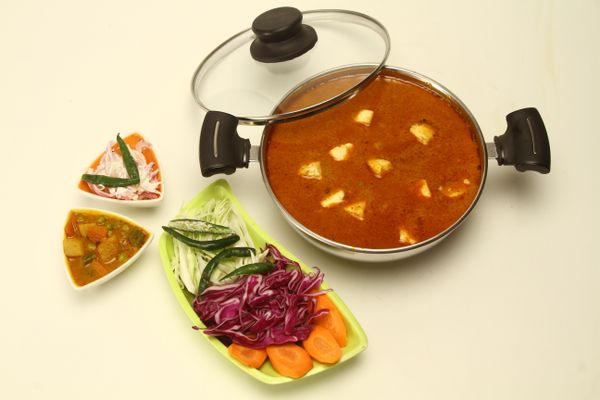
Dal is a category, not a dish
Almost every Indian region has a dal in its daily meal, and outsiders often assume these are variations on a single preparation. They are not. In one place it is a thin, sour, pourable liquid; in another a thick, buttery sauce; in a third something almost dry that is eaten as a vegetable. Those are different foods that happen to share an ingredient.
The variable that explains most of the difference is not the pulse and not the spicing. It is what the dal is being eaten with, because the staple decides what consistency is useful, and consistency then drives everything else.
Where rice is the staple, the dal is a liquid
Rice served in a heap needs something poured over it, and it needs enough of that liquid to moisten every grain. A thick sauce cannot do this — it sits on top, and mixing it in produces a paste rather than a moistened plate. So in the rice-eating south and east, the daily dal is thin enough to pour and generous enough in quantity to wet a whole serving.
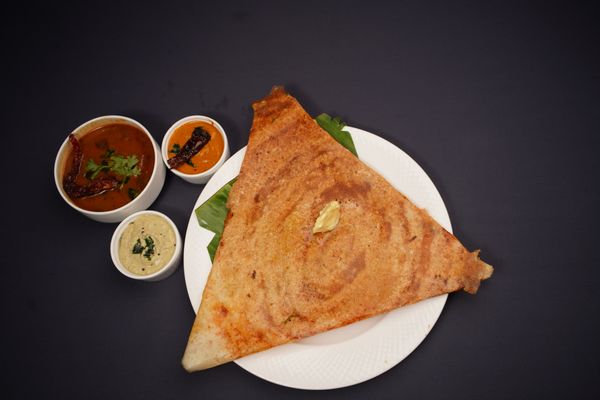
Sambar takes this furthest, being effectively a soured, vegetable-laden broth built on toor dal, and rasam thinner still, close to a drinking consistency and meant to be taken with rice at a specific point in the meal. Neither would work as a scooping sauce, and neither is trying to.
The sourness is part of the same logic. A large volume of thin liquid needs something to keep it from tasting bland and watery, and acid — tamarind, tomato, kokum depending on where you are — does that far more efficiently than fat or salt could at that dilution.
Where flatbread is the staple, the dal is a sauce
Bread picks food up rather than absorbing it, and a piece of roti dipped into a thin liquid comes out carrying almost nothing. So in the wheat belt, dal is thick enough to cling — reduced further, often enriched with fat, and served in smaller quantities relative to the bread.
That thickness changes what seasoning is possible. A concentrated dal can carry a heavier spice load and a substantial amount of ghee or butter without becoming greasy, because there is enough body to hold it. The long-cooked black dal of the north is the extreme case: cooked for many hours until the pulse has broken down entirely into something closer to a sauce than a soup.
It also changes the pulse. Chana and its split forms hold their shape and give body, masoor breaks down quickly into a smooth thickness, and both suit a preparation meant to cling. Which pulses were locally grown and which behaved the right way for the local staple tended to reinforce each other.
The dry versions and why they exist
A third category is barely liquid at all — pulses cooked until just tender and then finished with a tempering, coconut or spices, and served as a dry side. These appear widely but are especially characteristic of the south and west, where a meal is assembled from several small dishes rather than one main gravy.
The reason is structural rather than culinary. When a plate already contains a liquid dal and a rasam, a third wet dish adds nothing, so the pulse in that slot does a different job: texture, and something to eat in the hand or with a dry portion of rice. A meal built as a set of contrasts needs at least one component that is not wet.
This is also where whole pulses tend to appear rather than split ones, since the point is grains that hold their shape and can be identified individually. Split, skinned dals collapse, which is exactly what you want in a sauce and exactly what you do not want here.
Reading a regional dal correctly
Once you see that consistency is the primary variable, a lot of otherwise puzzling instructions make sense. A recipe that insists on adding a great deal of water and then not reducing it is not being careless; it is producing something meant to be poured. A recipe that says to cook it down until a spoon leaves a trail is producing something meant to be scooped.
The same logic explains why regional dals travel badly. Made correctly and served with the wrong staple, a thin sambar next to rotis is unsatisfying and a thick northern dal over rice is stodgy — not because either is wrong, but because each was designed against a partner that is missing.
And it explains the fat. A dal finished with a spoonful of ghee at the table, common across the north, only makes sense at a consistency where the fat sits on the surface and gets picked up. Stir the same ghee into a litre of thin sambar and it disappears, which is why that is not how it is done there.
Common questions
Which pulse should I use if a recipe just says dal?
Look at the consistency the recipe is aiming for. Toor and masoor break down and suit anything pourable or saucy; moong is mild and quick and suits light everyday preparations; chana and whole pulses hold their shape and suit thicker or drier dishes.
Why do some dals need a pressure cooker and others do not?
Whole pulses with intact seed coats resist water and take a long time, so pressure genuinely helps. Split, skinned dals like moong and masoor have no such barrier and cook to softness in an open pan in a reasonable time.
Is a mixed dal a real tradition or a shortcut?
It is a genuine tradition in several regions, and there is sense in it: combining pulses that break down with pulses that hold shape gives you body and texture at once. It is not a compromise, though it does make the cooking time harder to judge.
Consumer editor, Wah Taste
Nadia has written about everyday cooking, street food, spice & pantry for most of the last decade and is unreasonably interested in the detail nobody else checks.