A staple is whatever survives the local weather
The broad division in Indian staples — rice in the south and east, wheat in the north and west, millets across the dry interior — is not a matter of preference and never was. It is an almost direct readout of rainfall, temperature and soil, because a staple crop is by definition the one that can be grown reliably enough to feed a population every single year.
Rice is a thirsty crop that wants standing water and heat. Wheat is a cool-season crop that wants a cold winter and moderate water. Millets want very little of anything and will produce a harvest on land where both of the others fail. Draw those three requirements on a map of the subcontinent and you have drawn the culinary regions.
Why the south ferments and the north does not need to
Rice has almost no gluten-forming protein, so a rice dough cannot be stretched, rolled thin or made to hold gas. A wheat dough can do all three. That single structural difference forces the two halves of the country down completely different roads for making a flat, cookable bread.
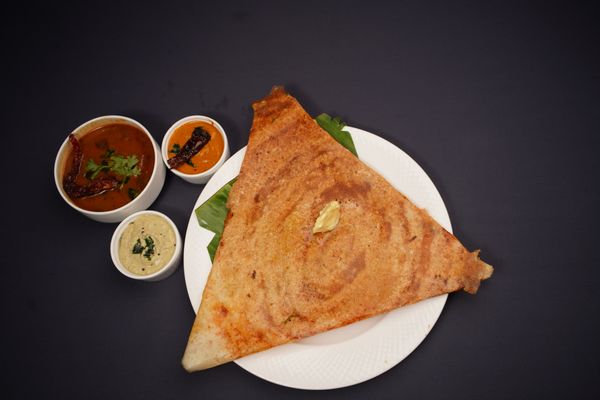
The southern solution is fermentation. Ground rice and urad dal, left overnight, are colonised by naturally occurring bacteria and yeasts that produce acid and carbon dioxide. The gas gives lift that no gluten network is providing, the acid changes the flavour profile entirely, and the urad dal contributes proteins and gums that give the batter enough structure to hold that gas in the first place.
And fermentation is only reliable where it is warm. A batter that ferments in eight hours in coastal Tamil Nadu may take a day and a half in a north Indian winter, which is a real practical constraint on a food eaten daily. The technique belongs to the climate as much as the crop does.
The wheat belt takes a different route to the same place
Where wheat grows, gluten does the work that fermentation does further south. Knead a wheat dough and the protein network forms; roll it and it holds together; heat it and the steam inside inflates it against that elastic network. A roti puffs for structural reasons that have nothing to do with any organism.
Because the leavening is physical rather than biological, the whole timescale changes. A roti dough rests for half an hour, not overnight, and it can be made at the point of eating. That fits a kitchen rhythm quite different from one where the next morning’s breakfast has to be ground and set to ferment the previous evening.
It also means the northern flatbread carries none of the sourness that fermentation produces, which shapes everything served alongside it. Sourness in a northern meal comes from curd, tomato or pickle placed next to the bread, rather than from the bread itself.
The millet belt is the part people forget
Across the dry Deccan, parts of Rajasthan, Gujarat and Karnataka, the historical staple was neither rice nor wheat but millets — jowar, bajra, ragi. These grow on poor soil with unreliable rain and short seasons, and they fed enormous populations in regions where the other two staples were simply not viable.
Millets have no gluten either, and they do not ferment into a batter the way rice and urad do. The solution there is a third technique: a dough made with hot water, patted out by hand rather than rolled, and cooked immediately. Hot water partly gelatinises the starch, and that gelatinised starch acts as the binder that gluten would otherwise be.
This is why bhakri and its relatives are patted rather than rolled, why they are made one at a time, and why the dough does not keep. The method is dictated by the absence of both the crop-scale options available elsewhere, and it is a genuinely clever solution rather than a poorer version of a roti.
What the staple does to everything around it
A staple determines the shape of the whole meal, because it determines what the accompanying dishes have to do. A thin, absorbent rice-based meal needs a liquid to moisten it — hence sambar, rasam, and the tradition of pouring. A dry flatbread needs something to scoop, so northern gravies are thicker and more concentrated, since they will be picked up rather than poured over.
The pulse follows too. Toor and urad dominate where they grow well in the south and the Deccan; chana and masoor are far more prominent in the north. And because the staple sets how much liquid the meal needs, the same pulse ends up cooked to a thin, pourable consistency in one region and a thick, scoopable one a few hundred kilometres away.
None of these boundaries is sharp any more, since grains now travel and a city kitchen can cook anything. But the techniques were shaped when they could not, and that is why they look the way they do.
Common questions
Can dosa batter be fermented in a cold climate?
Yes, it just needs help — a warm spot, a longer time, or an oven with only the light on. The organisms are present on the grains and in the air; they are simply slow below about 25°C, and a batter that has not risen and smelled faintly sour is not ready.
Why does idli need urad dal specifically?
Urad contributes proteins and mucilaginous compounds that trap the gas produced during fermentation, effectively doing the job gluten does in bread. A rice-only batter ferments but cannot hold the bubbles, so the result is flat.
Are millets harder to cook with?
They behave differently rather than being harder. Without gluten they will not tolerate rolling or long resting, so the techniques built around them are quick and hands-on. Doughs made with hot water and cooked immediately are the traditional answer and still the most reliable one.
Consumer editor, Wah Taste
Nadia has written about everyday cooking, street food, spice & pantry for most of the last decade and is unreasonably interested in the detail nobody else checks.