The same food, three geometries
Most Indian home kitchens run on a very small set of vessels, and the set is remarkably consistent across regions that agree on almost nothing else. There is something flat and shallow, something deep and curved, and something that locks shut. The differences between them are usually described in terms of what dishes they make, which puts the effect before the cause.
What actually distinguishes them is surface area relative to volume, and therefore how quickly water can leave the food. Everything else follows from that single variable.
The flat pan maximises the escape route
A tava is essentially all surface. Whatever sits on it presents its full width to open air and receives heat through direct contact with metal on one side only, which means moisture at the exposed face leaves as fast as heat arrives at the hidden one. Nothing pools, because there’s nowhere for liquid to pool.
That makes it the right tool for anything that has to dry out and brown rather than soften. A flatbread is not being cooked so much as dehydrated at the surfaces while the interior steams itself, and the puffing that a good roti does depends on the outside setting into a skin while the inside is still wet. A curved pan would trap the steam that has to escape and the bread would go leathery.
The other consequence is that a tava has no tolerance for excess liquid. Put a watery mixture on one and it spreads thin, boils and then catches, because a wide film of liquid over hot metal loses its water almost instantly and what remains is solids on a griddle.
The curved pan concentrates instead
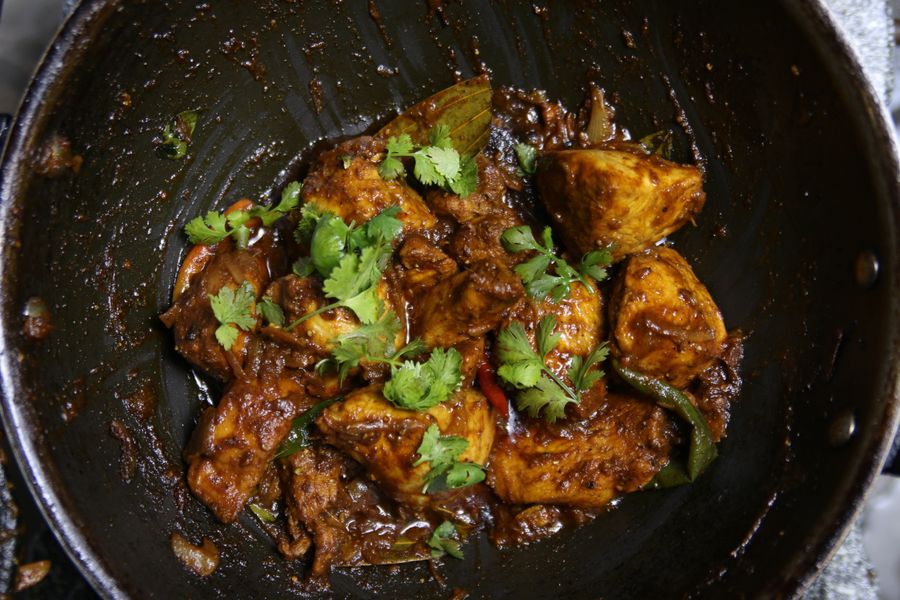
A kadhai does the reverse. Its depth and curve mean that a small quantity of fat gathers into a genuine pool at the bottom rather than spreading into a film, so you can deep-fry in a fraction of the oil a straight-sided pan would need. Food slides back towards the centre instead of drifting to a cool edge.
The curve also gives you two heat zones at once. The base sits directly over the flame and is fierce; the sloping sides receive far less and are a place to park things that are already done. Cooks who work quickly use that constantly, moving pieces up the wall to hold and down to finish, and it is a genuine loss on a flat-bottomed pan where every part of the surface is the same.
For a gravy, the shape means the liquid is deep and the exposed surface small, so evaporation is slow and controlled. That is what you want when a sauce has to simmer for half an hour without becoming a paste.
The sealed pot refuses evaporation entirely
A pressure cooker takes the argument to its end and simply does not let water leave. Because the vapour can’t escape, pressure rises, and because pressure rises, the boiling point rises with it — so the food is cooking in liquid that is hotter than boiling water can normally be.
That is transformative for things that are slow because they need heat and time rather than drying: pulses, tough cuts, whole grains, anything where the obstacle is structural material softening. It is useless, and often destructive, for anything whose quality depends on a dry surface or a reduced sauce.
It also removes the cook from the process. You cannot taste, stir, adjust or look, so every decision has to be made before the lid goes on. That is a fair trade for a dal and a bad one for something delicate.
Substituting one for another isn’t neutral
Recipes rarely say why they specify a vessel, so substitution feels harmless. Sometimes it is. But a dish that expects reduction in a wide pan will stay thin in a deep one, and a dish that expects a small hot pool of oil will absorb far more of it spread across a flat base.
The most frequent mismatch is finishing a pressure-cooked dish without ever opening it up. Whatever water went in is still in there, and if the recipe assumed some of it would leave, the result is correct in flavour and wrong in consistency. A few minutes with the lid off is the whole fix.
None of these tools is more advanced than the others. They are three settings on one dial, and the dial is water.
Common questions
Can I use a kadhai for flatbreads?
Poorly. The curve means only a small ring of the bread touches hot metal, so it cooks in a circle and stays pale everywhere else, and the trapped steam softens the surface you are trying to dry. A flat pan is doing something a curved one structurally cannot.
Why does the same recipe come out thicker in my pan than in the picture?
Usually the width. A wider pan exposes more surface to the air, so more water leaves in the same time and the sauce reduces faster. Neither pan is wrong; you’re simply further along the same process at the point the timer told you to stop.
Is a heavy pan always better?
Not always, but it is more forgiving. Mass evens out the heat and stops the temperature crashing when cold food arrives, which helps for anything long and slow. For something that needs to respond instantly to the flame going down, that same mass works against you.
Consumer editor, Wah Taste
Nadia has written about everyday cooking, street food, spice & pantry for most of the last decade and is unreasonably interested in the detail nobody else checks.