Two processes with one name
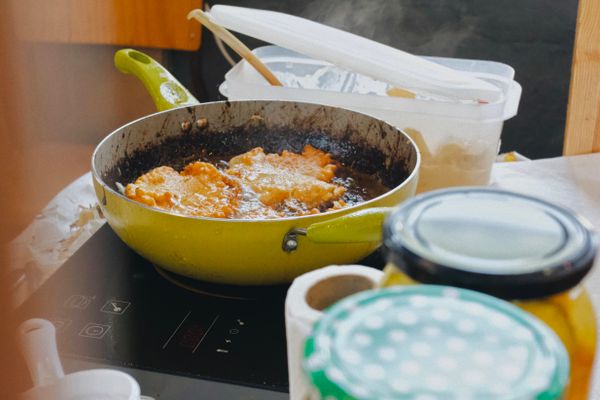
Everything that goes brown in a pan gets described as caramelising, and most of the time that word is wrong. There are two quite different chemical routes to a brown surface and a roasted smell, they need different conditions, and they produce different flavours. Knowing which one a dish depends on tells you what the pan needs to be doing.
Caramelisation is sugar breaking down under heat, on its own, without needing anything else present. The Maillard reaction is a set of reactions between sugars and amino acids — that is, between the sugar and the protein in the food. Both give brown colour and complex aromas, and there the similarity ends.
What each one needs to happen at all
Caramelisation requires a genuinely high temperature. Ordinary table sugar does not begin breaking down in any meaningful way until it is well above the temperature of boiling water, and different sugars have different thresholds. Nothing in a wet pan will caramelise, because a wet pan cannot get hot enough while there is still water in it.
The Maillard reaction gets going at considerably lower temperatures, and it will proceed slowly even at ordinary cooking heat given enough time. It needs the reducing sugars and the amino acids to be able to find one another, which means it goes much faster once surface moisture has gone, and it is inhibited in acidic conditions and encouraged in mildly alkaline ones.
That last detail is the reason a pinch of baking soda makes onions brown dramatically faster. Raising the pH speeds the Maillard reaction substantially. It also softens the onion by attacking pectin, so overdoing it gives you a brown, mushy, faintly soapy result — a genuine trick with a narrow useful range.
Why the browning of onions is mostly not caramelisation
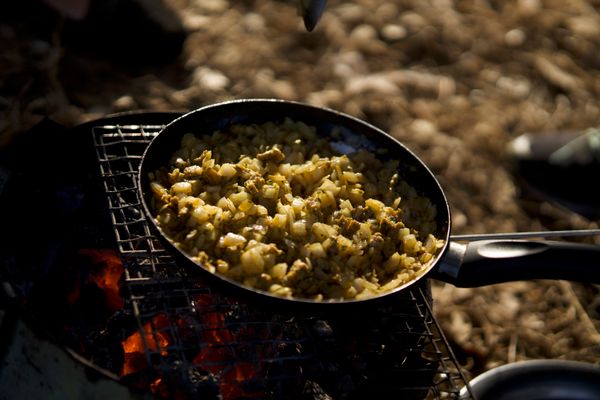
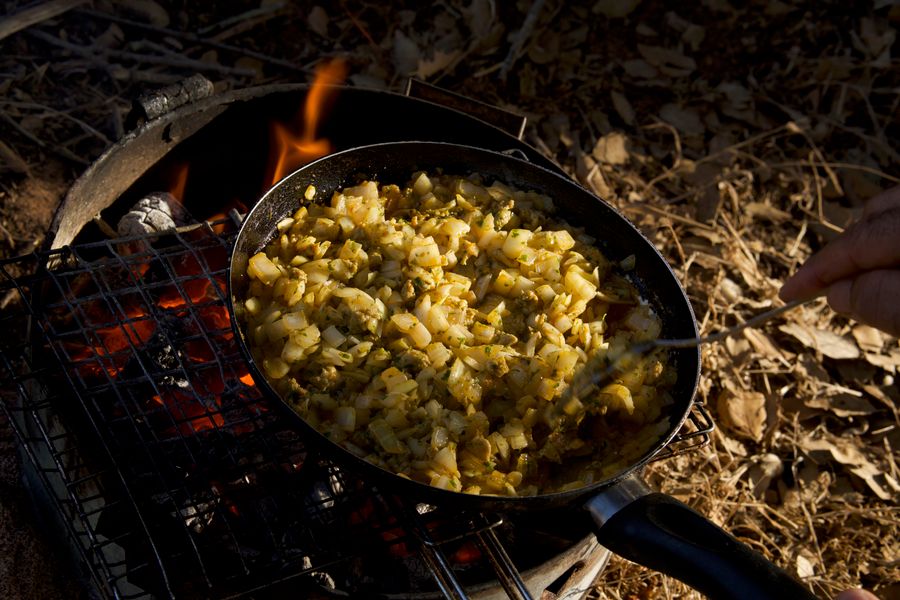
Onions are frequently described as caramelising, and there is some sugar chemistry involved, but the majority of what happens in a pan of slowly browned onions is Maillard. Onions contain both sugars and amino acids, and the temperatures a home pan reaches are far more favourable to one reaction than the other.
The reason it takes so long is that nothing can start until the water has gone. An onion is around nine-tenths water by weight, and every bit of that has to evaporate before the surface can rise past boiling point. The first fifteen minutes are drying, not browning, and they cannot be skipped by turning the heat up — a high flame just scorches the outside while the interior is still releasing moisture.
This also explains why the recipe instruction to brown onions in five minutes is not achievable and never was. The physics of evaporating that much water sets a floor on the time, and the only real levers are more surface area, a wider pan, and patience.
Different flavours, not just different speeds
The two reactions produce genuinely different flavour compounds. Caramelisation gives the sweet, slightly bitter, distinctly sugary notes that belong on the surface of something that started as sugar. Maillard products are savoury, roasted and meaty, and there are hundreds of them, which is why a browned surface tastes complicated in a way a raw one does not.
In practice most browning in a savoury Indian pan is a mixture, weighted heavily towards Maillard, with some sugar breakdown alongside it. A browned onion base tastes both sweet and savoury for exactly that reason, and the balance shifts depending on how hot and how long the pan ran.
The compounds produced are also mostly not water-soluble, which is why they need fat to distribute through a dish and why a browned base disperses its flavour so effectively through a gravy. The browning happens on a surface; the fat carries it everywhere.
The practical consequences in a real pan
Everything follows from the water rule. A crowded pan releases more moisture than it can evaporate and the food steams instead of browning. A lid does the same thing deliberately. A wet ingredient added early — tomatoes, yoghurt, a splash of water — resets the surface temperature to boiling and stops browning until it has gone again.
That is why so many recipes look like a sequence of drying steps: brown the onions, then the ginger and garlic, then the tomatoes until the fat separates, then the spices. Each addition floods the pan with water and each step is waiting for that water to leave before moving on. The instruction to cook until the oil separates is a moisture gauge — free oil pooling at the edges means the water is largely gone.
And there is a limit worth respecting. Past a certain point browning becomes burning, the compounds produced turn bitter and acrid rather than complex, and there is no recovering from it. Dark is good. Black is a different chemistry and it will dominate everything else in the pot.
Common questions
Does adding sugar help onions brown?
A little, and it changes the character towards the sweeter end, but it is not necessary — onions already contain plenty of sugar. If your onions will not brown, the problem is almost always moisture or crowding rather than a lack of sugar.
Why does my masala taste raw even after long cooking?
Usually because it has been simmering in a wet pan the whole time. Spices need contact with hot fat to change, and a pot that has been at boiling point for an hour has never given them that. Fry the masala in oil before the liquid goes in.
Is browned food less healthy?
Very heavily charred or burnt food produces compounds that have been the subject of long-running research and discussion, and the general advice is to avoid heavy blackening. Ordinary browning is a normal part of cooking almost everywhere, and this is an area where nuance matters more than a rule.
Reporter, Wah Taste
Gautam covers everyday cooking, street food, spice & pantry and the questions readers actually send in and is unreasonably interested in the detail nobody else checks.