Gloss is not a cosmetic property
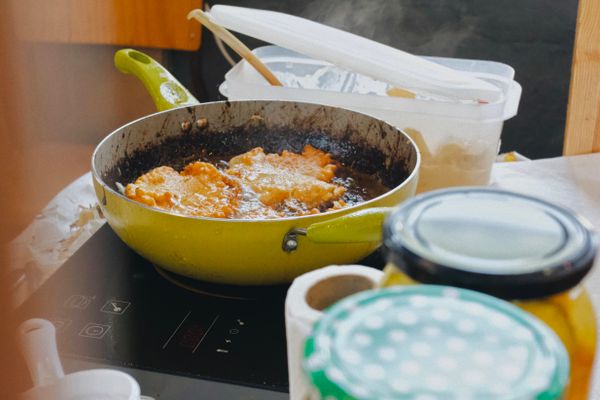
A gravy that looks rich and glossy and one that has a slick of oil sitting on top may contain exactly the same ingredients in exactly the same proportions. The difference is physical arrangement. In the first, the fat is broken into droplets small enough to be suspended throughout the water; in the second, those droplets have merged and floated.
That arrangement is not just a matter of appearance. It changes how the sauce coats a piece of bread, how quickly flavour is released in the mouth, and how the dish feels — because fat delivered as fine droplets throughout a liquid reads as richness, while the same fat sitting on the surface reads as greasiness.
Why oil and water separate in the first place
Fat and water do not mix because their molecules interact very differently. Water molecules are strongly attracted to one another and exclude anything that cannot participate, which pushes fat molecules together into ever larger droplets until they form a continuous layer. Left alone, that is always where the system ends up, because it has the smallest possible contact area between the two.
To hold an emulsion, you need two things. First, energy to break the fat into small droplets — that is what stirring, whisking and vigorous simmering supply. Second, something at the boundary of each droplet to stop it merging with its neighbours when it bumps into them.
That second thing is the emulsifier, and Indian gravies are full of them without anyone naming them as such. It is a genuinely useful way to look at a recipe, because it reframes several ingredients that look like flavourings as structural components.
What is actually holding the emulsion together
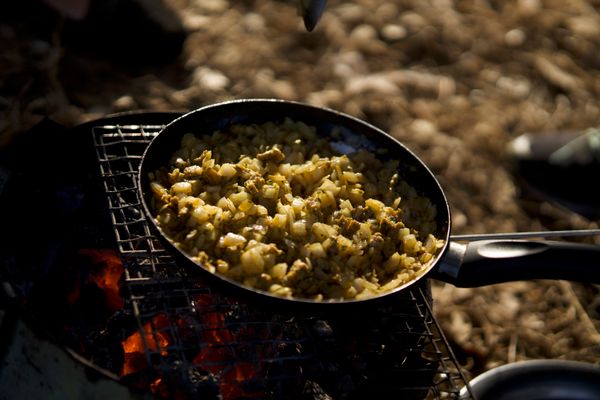
Onion paste is doing a great deal of this work. It contributes both solid particles and soluble compounds that sit at the fat-water boundary, and the sheer quantity of finely divided plant material in a well-cooked onion base physically obstructs droplets from finding each other. This is a large part of why a properly made onion base produces a sauce with body that a thin one lacks.
Nut and seed pastes — cashew, melon seed, poppy seed, almond — are more efficient still, because they bring protein and their own fat along with starch. Proteins are natural emulsifiers, having regions that are comfortable in water and regions that are comfortable in oil, so they sit at the interface and stabilise it. Dairy does the same thing through milk protein.
Starch works by a different route. It does not sit at the boundary; it thickens the water phase so much that droplets simply cannot move around fast enough to collide and merge. Any thickener slows separation, which is why a reduced gravy holds together better than a thin one made from the same things.
The moment the oil separates, and why it is sometimes wanted
Indian recipes very often instruct you to cook a masala until the oil separates, which sounds like the opposite of everything above. It is not a contradiction — it is a deliberate use of separation as a signal. When free oil appears at the edges of the pan, it means the water has gone, and that is the point at which the base has finished cooking.
What happens next is the important part. Liquid is added, the mixture is stirred and brought back to a simmer, and the separated oil is re-dispersed into the new water phase, this time with a properly cooked base full of emulsifiers to hold it. The separation was a checkpoint, not an end state.
A finished dish that separates is a different matter and usually means one of three things: not enough emulsifier for the amount of fat, too little agitation, or the sauce sitting undisturbed at high heat, which encourages droplets to coalesce. Reheating a gravy gently and stirring it will often bring it back.
Temperature and time both work against you
Emulsions are not stable in the way a solution is. They are metastable — they persist because something is slowing the inevitable, not because separation has been prevented. Heat gives the droplets more energy and makes collisions more frequent, so a sauce held at a hard boil will separate faster than one held at a bare simmer.
Time does the rest. A gravy left standing will show a film of oil on top within an hour, which is entirely normal and easily fixed by stirring it back in over gentle heat. That is a different problem from a broken sauce, where the fat has merged into a substantial layer and needs both heat and vigorous stirring to re-disperse.
The practical version is unglamorous. Build a base with enough finely divided solids in it, add fat in stages rather than all at once, keep the sauce moving as it comes together, and simmer rather than boil. Gloss is the visible confirmation that all of that happened.
Common questions
Why do restaurant gravies look so much glossier?
Mostly because they contain more emulsifying material — onion or nut pastes cooked down heavily, cream, or a base gravy prepared in bulk and blended. Blending is significant on its own, since it mechanically breaks the fat into finer droplets than stirring can.
Can I fix a gravy where the oil has separated?
Usually. Warm it gently and stir steadily, and add a small amount of something with emulsifying power — a spoonful of yoghurt, cream, or a little of the onion base. Adding a splash of hot water while stirring often helps re-disperse the fat.
Is blending a gravy cheating?
It is a technique, and a traditional one in many kitchens where the base is ground rather than chopped. It changes the texture towards smoothness and away from anything you can identify by bite, which is a legitimate choice rather than a shortcut.
Staff writer, Wah Taste
Omkar has been reporting on everyday cooking, street food, spice & pantry since long before it was fashionable and thinks most subjects are more interesting once you know how they work.