Three components, one dough
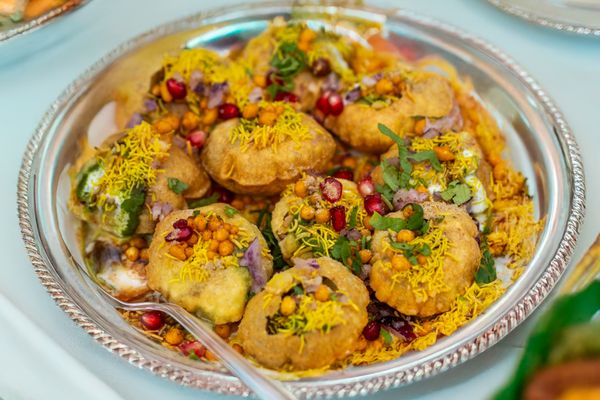
Look at what goes on top of a plate of chaat and there is a surprising amount of overlap. Sev is a fine extruded thread, boondi is a small sphere dropped through a perforated ladle, papdi is a rolled and cut disc. All three are essentially the same short list of ingredients — a flour, a fat, salt, some seasoning, water — and all three are fried.
They are wildly different to eat. The difference isn’t in what they are made of. It is in how thick the piece was when it hit the oil.
That sounds like an oversimplification and it very nearly is one, since the flour blend and the fat content do matter. But if you had to predict how a fried crisp will behave from a single measurement, thickness would beat every other candidate by a wide margin.
Crispness is the absence of water, nothing more
A fried piece becomes crisp when almost all the water has been driven out of it and what remains is a rigid network of set starch and protein. That network shatters under pressure instead of bending, and shattering is what we perceive as crunch. Anything still holding a meaningful amount of moisture will yield rather than break.
Water leaves through the surface, and it has to travel from wherever it started to get there. In a thread a fraction of a millimetre across, that journey is essentially nothing and the piece dries through completely in seconds. In a disc several times thicker, the outside dries long before the middle does, and the middle may never dry at all.
This is the whole explanation for the different textures. Sev is uniformly brittle because it dried uniformly. Papdi has a hard shell and a slightly denser, less brittle interior. Boondi sits between them and varies enormously with the size of the perforations.
Thickness also decides how much oil ends up in the piece
While water is leaving as steam, that outward flow physically opposes oil moving inwards — the pressure is going the wrong way for oil to penetrate. Oil mostly enters after the frying, as the piece cools and the steam inside condenses, creating a slight vacuum that draws surface oil in.
A thin thread has almost no interior for oil to be drawn into, so it carries mainly what clings to its surface. A thicker piece has volume, and volume that has just given up its steam is a space waiting to be filled. That is why the heavier crisp elements taste richer and go stale in a different way.
It is also why draining while hot matters more for thick items than thin ones. The oil that is on the surface at the moment of cooling is the oil that gets pulled in.
Fat in the dough does something separate again
Fat rubbed into the flour before the water arrives coats flour particles and physically interrupts the network that would otherwise form, which produces a piece that breaks short and clean instead of being tough and glassy. Without it, a thin fried strand can be unpleasantly hard rather than crisp.
Gram flour behaves differently from wheat flour here because it has no gluten to interrupt in the first place, so its fried texture is naturally more crumbly and more prone to going dense if the batter was overworked or over-hydrated. Blends of the two are common for exactly this reason.
The seasoning goes into the dough rather than onto the surface for a practical reason: anything sprinkled on afterwards falls off, and anything applied wet undoes the drying the frying just achieved.
Why a plate uses several of them at once
A chaat that used only one crisp element would be monotonous in a way that’s easy to underestimate. Texture registers over time — the first crack, the resistance, how long the piece takes to break down — and three different thicknesses give three different durations in the mouth.
They also fail at different rates once the wet components arrive. The fine threads go soft almost immediately, the thicker discs hold for a good while longer, and that staggering is why a well-built plate still has something crunchy in the last mouthful.
Order of assembly follows from that. The elements that survive go in early and low; the fine ones go on top at the last possible moment, which is why the vendor showers the sev over the plate as they hand it across rather than before.
Common questions
Why does homemade sev come out soft?
Almost always the oil temperature or the dough hydration. A thread that thin needs oil hot enough to drive the water out fast; in cooler oil it cooks through while still holding moisture, and a wet dough gives it more water to lose than the frying time allows.
Can these be baked instead of fried?
You can dry them out with hot air and get something brittle, but it is a different product. Oil transfers heat far faster than air, and the speed is what produces the particular open structure and the clean break. A dried version is harder and more uniform.
Why do these go stale in an open packet even in a dry room?
Because they are drier than almost anything around them, so the moisture gradient runs from the air into the crisp. It doesn’t take much absorbed water to soften that rigid network — well below the point where the piece would feel damp to the touch.
Editor, Wah Taste
Sanaya has written about everyday cooking, street food, spice & pantry for most of the last decade and prefers a plain explanation to a clever one.