Not the same problem, larger
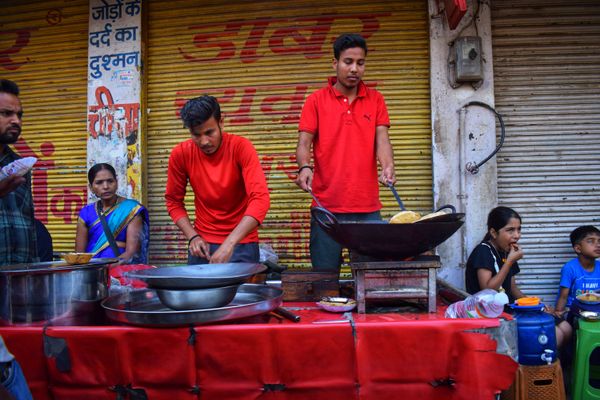
Cooking for one has a well-known set of difficulties, and cooking for a crowd is often assumed to be the same difficulties inverted. It is not. Multiplying quantities is arithmetic, but almost nothing else about a large batch scales in a straight line, and the failures aren’t the failures of a small pan made bigger.
The physics changes first. A big pot has far more mass relative to the area through which heat enters and leaves it, so it responds slowly to everything you do — and once it is hot it stays hot for a very long time.
A large pot is a slow instrument in both directions
A domestic pan reacts to the flame within seconds. A deep pot holding several kilograms of food does not, because the heat has to travel through the mass by conduction and convection, and both of those take time. Turning the heat down does not stop the cooking. It slows the rate at which more heat is being added while the pot continues to cook everything in it with what it already has.
That carry-over is the single most common cause of overcooked food at scale. Something judged perfect at the moment the flame went off keeps cooking for another quarter of an hour, and by the time it is served the vegetables have gone. Experienced batch cooks stop noticeably early, and it looks like a mistake right up until the point where it turns out not to be.
The same inertia is an advantage on the way up. A heavy pot does not lose its temperature when a large quantity of cold ingredients goes in, which is why a big vessel over a strong flame can handle additions that would stall a small pan completely.
Beyond a certain depth, browning isn’t on offer
Browning requires the surface of the food to become dry and hot, and in a deep pot most of the food is not at a surface. It is in the middle, surrounded by other food and by steam, at boiling point, cooking in a wet environment no matter how ferocious the flame under the base.
This is why large-scale cooking almost always separates the browning from the bulk. The aromatics, the masala and anything that needs colour get made in a manageable quantity where they can actually reach the necessary temperature, and only then are they combined with the mass. The base is built small and the dish is finished large.
Trying to skip that stage produces the characteristic flat taste of institutional food. Nothing is wrong with it exactly. It simply never had the stage where flavour is created rather than merely mixed.
The menu has to be chosen for how it holds
Food for a crowd is almost never eaten the moment it is finished. There is a gap — sometimes an hour, sometimes more — and the dishes that survive that gap are not the same as the dishes that are best straight off the stove.
What holds well tends to have three things: enough liquid that it does not dry out, enough fat that it stays glossy and doesn’t set, and enough acid or salt to stay stable while warm. Gravies hold. Dals hold, and often improve. Anything crisp does not hold at all, which is why crisp elements at a large meal are fried at the last minute or served separately.
Fresh, delicate and just-finished are genuinely difficult to deliver at volume, and pretending otherwise is how caterers end up serving something soft that was meant to be sharp.
Seasoning at depth is a distribution problem
Salt and spice do not simply multiply, but the reason is not only about perception. In a deep pot, anything added at the top has a long way to travel, and stirring a heavy mass properly is real physical work that often does not happen thoroughly enough. A dish can be correctly seasoned on average and wrong everywhere.
Adding seasoning in stages as the pot fills, rather than all at the end, mostly solves it. So does tasting from the bottom rather than the top, which is where the salt has settled and where the heat has been most intense.
And one small thing worth knowing: a large pot loses much less water proportionally than a small one, because its surface is small relative to what it contains. Scale a recipe up faithfully and you will usually end up with something thinner than you expected.
Common questions
Can I just multiply the spices by the number of servings?
For salt and most ground spices you can get close, but chilli heat and anything strongly aromatic tend to feel stronger at scale than the multiplication suggests. Adding somewhat less than the arithmetic says and correcting upwards is the safer direction, since there is no way back.
Why does the cooking take longer than the recipe even on a big flame?
Because the heat enters through the base only, and the base hasn’t grown in proportion to the volume. Twice the food does not get twice the burner, so the energy per kilogram is lower and everything takes longer to come up to temperature.
Is it better to cook one huge batch or several normal ones?
It depends on the dish. Anything that relies on browning or reduction is usually better in several batches combined at the end. Anything that is essentially a long simmer is easier and more consistent in one pot, and gains from the steadier temperature.
Consumer editor, Wah Taste
Nadia has written about everyday cooking, street food, spice & pantry for most of the last decade and is unreasonably interested in the detail nobody else checks.