A vegetable people cook defensively
Bhindi is one of the few vegetables that arrives in a kitchen with a warning attached, and the warning is usually passed on as a list of prohibitions rather than an explanation. Wipe it, do not wash it. Dry the knife. Do not cover the pan. Add something sour. Each of those instructions is sound, and each of them is aimed at exactly the same underlying variable, which is why they are so often given as a set.
The variable is water, and specifically water in contact with a cut surface. Heat isn’t the trigger, and neither is the knife on its own. Once you’ve seen that, the list stops being folklore and becomes a single rule applied in five places, and the pod’s reputation looks a good deal less mysterious.
Mucilage is a substance, not a defect
What people call slime is mucilage, a group of large water-loving carbohydrates stored in specialised cells running through the pod wall and packed around the seeds. Plants make these for good reasons of their own — they hold water, they help seeds hold together, and they line surfaces that would otherwise dry out. Okra is unusual only in how much of it there is and how close to the surface it sits.
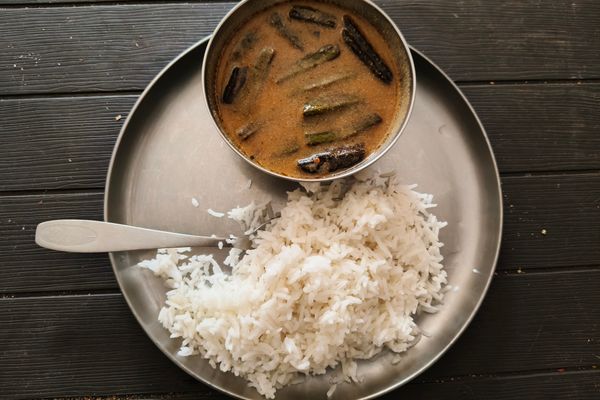
These molecules are long chains that trap water between them, and a very small amount of the substance can thicken a surprising volume of liquid. That is a useful property rather than a fault, and a good deal of cooking with okra exists to exploit it rather than to fight it. Sambar and thick stews take body from exactly the material a dry sabzi is trying to avoid.
Cutting opens the cells and water empties them
An intact pod holds its mucilage inside intact cells, where it does nothing at all to the outside of the vegetable. Cut across the pod and you open a ring of those cells to the air, but even then the material stays roughly where it is until liquid water arrives to dissolve and carry it. This is why a pod washed and cut while still damp behaves so differently from one wiped dry an hour earlier.
It also explains why the pods are sold with their stems on and why a careful shopkeeper will not let you rummage. Every bruise is a set of broken cells waiting for the first drop of water, and a pod handled roughly on the way home has done part of the damage before it reaches the board. Wiping with a dry cloth and cutting shortly before cooking is not fastidiousness so much as sequencing.
The same logic explains the wet knife, the crowded pan and the lid. A blade with moisture on it smears dissolved mucilage across every subsequent cut. A pan packed too full traps the water leaving the vegetable so that the pieces sit in their own steam. A lid returns that steam as condensation, which lands back on the cut faces and does the job all over again.
Heat and acid both break the chains down
Prolonged heat, especially in the presence of an acid, gradually breaks those long carbohydrate chains into shorter ones that no longer hold water in the same way. That is the mechanism behind the spoon of tamarind, the squeeze of lime or the tomatoes going in early, and it is a genuine chemical effect rather than a masking trick. It is also slow enough that adding acid at the last minute achieves very little.
Dry high heat works by a different route. Frying the cut pieces hard drives water off the surfaces quickly, and mucilage without water is a sticky film rather than a rope; it browns, it firms, and it stops behaving like a gel. This is why the same vegetable can come out of one pan slippery and out of another almost crisp with nothing changed but the amount of liquid present.
Age and size change what you are working with
A young pod is mostly tender wall with small soft seeds and a modest amount of mucilage. As it matures, the seeds harden, fibres develop along the ridges, and the mucilage content rises, so a large late pod is both tougher and slipperier than a small one from the same plant. Pressing the tip is the usual test — if it snaps rather than bends, the pod is young enough.
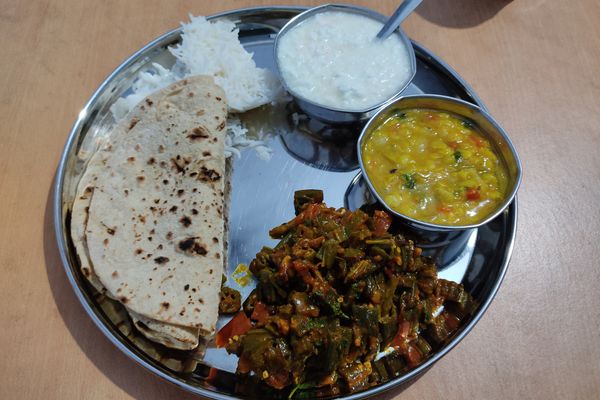
The seeds are worth a thought of their own, since they carry a fair share of the mucilage and all of the grittiness in an older pod. Slitting a large pod and stuffing it, which is how a good deal of okra gets cooked, keeps the cut surfaces to a minimum while still letting spice reach the inside, and that is a neat structural answer to the whole problem rather than a stylistic one.
Storage matters more than people expect too. Okra chills badly and develops dark, sunken patches after a few days in a cold fridge, and damaged tissue leaks. Keeping it dry and using it quickly is not fussiness; it is the same water problem arriving from a different direction, and no amount of careful cutting rescues a pod that has already begun to break down.
Common questions
Does adding curd or lime early really help?
Acid does break down the mucilage over time, so it has a real effect, but it needs heat and a reasonable stretch of cooking to work. A squeeze at the end changes the taste more than the texture. If a dish is meant to be dry, the frying does most of the work and the acid is a secondary tool.
Is the slipperiness worth avoiding at all?
Only in the dishes built around dryness. In a stew, a sambar or anything meant to be thick, the same material is doing useful structural work, and cooks in several regions choose okra precisely for that. The texture is a property to be placed, not a flaw to be removed everywhere.
Why do frozen pieces behave differently?
Freezing ruptures cell walls as ice crystals grow, so a thawed piece has already released much of what an intact pod keeps locked away, and it also carries surface water. That combination pushes it towards the slippery end. Cooking it from frozen in a hot, uncrowded pan gives the best chance of driving the water off before it can do much.
Features writer, Wah Taste
Nikhil writes about everyday cooking, street food, spice & pantry, mostly the parts other people skip and would rather show the working than assert the conclusion.