The same skeleton everywhere
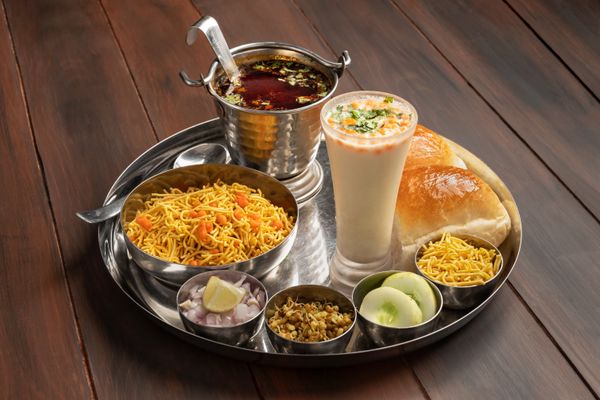
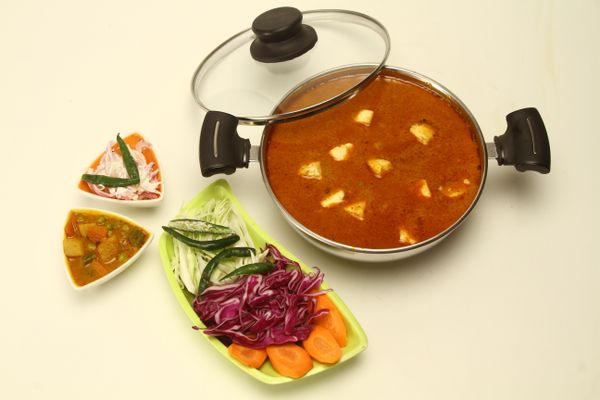
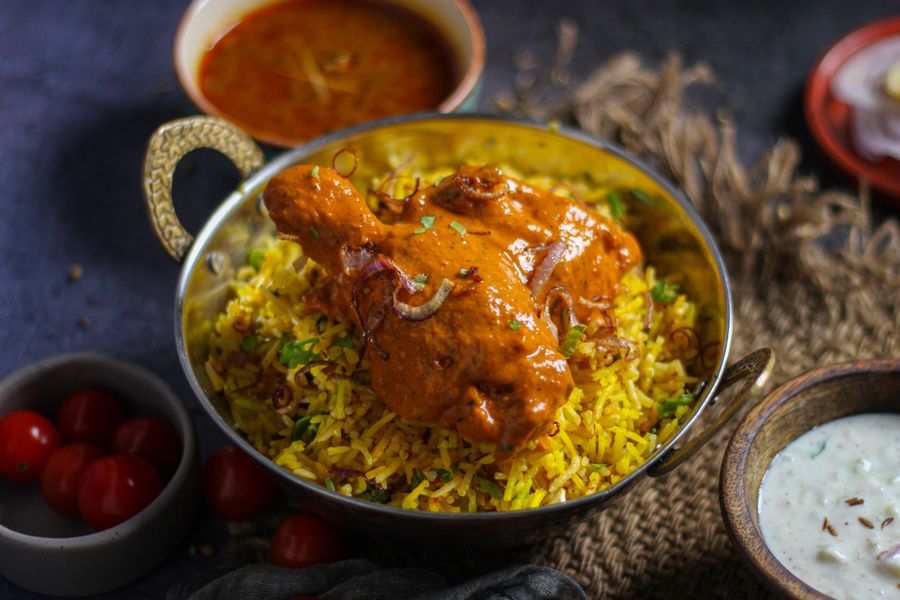
Thalis from opposite ends of the country can share almost no ingredients and still be recognisably the same object. Change the staple from rice to millet to wheat, change the pulse, change the vegetable, change the souring agent, and the shape of the meal survives all of it.
That is because the composition is a set of roles rather than a set of dishes. Once you can see the roles, an unfamiliar regional thali stops being a random assortment of bowls and becomes readable.
The roles aren’t written down anywhere and no cook recites them while serving. But they are consistent enough that you can predict, from two items on a plate, roughly what the remaining ones will be doing — and a plate that leaves one of them unfilled tends to feel incomplete in a way people notice without being able to name.
The staple is the base and everything is measured against it
Whatever occupies the largest area of the plate — rice, a flatbread, a millet bread — is nearly flavourless by design, and that neutrality is the point. It is the medium through which everything else is delivered, and it dilutes each intensely seasoned element down to something that can be eaten in quantity.
This is why the seasoning of the other items looks excessive tasted alone. A pickle eaten by the spoonful is unbearable; a fraction of that pickle with a mouthful of rice is correct. The concentration of every element on the plate has been set relative to how much staple will accompany it.
It also explains the portion sizes, which confuse people who read the small bowls as small servings. The bowls are concentrated; the plate is not. Refills go to the staple, not to the bowls.
A wet element and a dry one, which aren’t interchangeable
Almost every thali has at least one liquid preparation and at least one dry one, and they are doing opposite things. The liquid moistens the staple and makes it edible in bulk, and it carries salt and body through the meal. The dry item supplies texture, concentration and the sense of eating something rather than drinking it.
Take away the wet element and the meal becomes hard work. Take away the dry one and it becomes monotonous — a plate of rice and gravy with nothing to chew is oddly unsatisfying even when the gravy is excellent.
The regional differences here are almost entirely about the staple. Where the staple is rice, the liquid tends to be thin and generous; where it is a flatbread, the same pulse is cooked much thicker, because it has to be picked up rather than poured.
Acid, cooling and crisp are the three correctives
The remaining slots exist to fix things that a plate of staple, gravy and vegetable would otherwise get wrong. Something sour — a pickle, a chutney, a wedge of raw fruit, a sour lentil preparation — cuts richness and prevents the whole meal converging on one flavour by the third mouthful.
Something cooling, usually curd in one form or another, provides relief from chilli heat and a different temperature and texture. It also gives the eater a way to adjust the meal downward, which matters when one kitchen is feeding people with different tolerances.
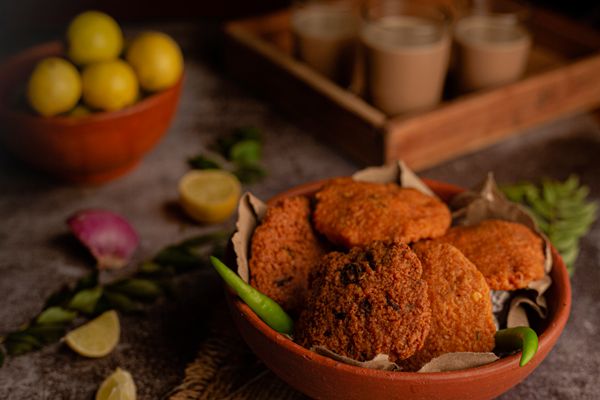
And something crisp, whether a fried papad, a fritter or a fried vegetable, supplies the only hard texture on a plate where everything else is soft. It is the first thing dropped when a meal is being simplified, and its absence is felt more than anyone expects.
Why reading the roles is more useful than reading the recipes
Composing a meal at home is much easier when you stop asking which dishes go together and start asking which slots are filled. A rich, wet main with a dry vegetable, something sour and some curd is a complete meal even if the individual dishes come from four different regions.
Conversely, a table with three rich gravies and no acid or crunch will feel heavy no matter how well each one was cooked, and adding a fourth gravy will make it worse. That is the commonest failure at ambitious home meals, and it is a compositional error rather than a cooking one.
None of this is a rulebook that anyone consciously follows. It is a pattern that has settled because it works, and it’s remarkably stable across regions that agree on nothing else about food.
Common questions
Is the arrangement on the plate meaningful, or is it habit?
Some of it is convention that varies locally, and some of it is practical — wet items in bowls so they do not run into everything, the staple where the eating hand naturally works, the pickle out at the edge because a little goes a long way. Reading deep significance into the exact positions is usually overreach.
Why is there often more than one vegetable?
Because one is typically wet and one dry, filling two different roles. When a thali has several vegetables they will usually differ in texture and cooking method rather than simply being two things from the market.
Can a simple home meal be a proper thali?
Certainly. Three items covering staple, something wet and something sour will already feel complete, and most everyday meals in India are far closer to that than to the elaborate versions served to visitors. The elaborate ones are hospitality, not the daily norm.
Consumer editor, Wah Taste
Nadia has written about everyday cooking, street food, spice & pantry for most of the last decade and is unreasonably interested in the detail nobody else checks.