A cheese with a very short history in the pan
Paneer is made by heating milk, adding an acid, and collecting the solids that separate out. That is the whole process, and it takes less than half an hour. There is no ageing, no culture worth speaking of, no rind and no ripening period, which makes it a fresh cheese in the strictest sense.
Its distribution across India is uneven in a way that follows dairy rather than taste. It is everywhere in the north and the northwest, where cattle and buffalo were kept in numbers and milk was a daily surplus rather than an occasional one, and it is far less traditional in regions where the protein of choice came out of a river or the sea.
Acid setting is what makes it behave the way it does
Most European cheeses are set with rennet, an enzyme that clips the protein molecules in a specific place and lets them build a network that can later be persuaded to flow again when heated. That is why those cheeses melt.
Acid setting works differently. Adding lemon juice, vinegar or sour whey to hot milk lowers the acidity to the point where the main milk protein loses the electrical charge keeping its clusters apart, and the clusters clump together indiscriminately. The network that forms is dense and disordered rather than structured, and heating it doesn’t make it flow — it makes it tighten.
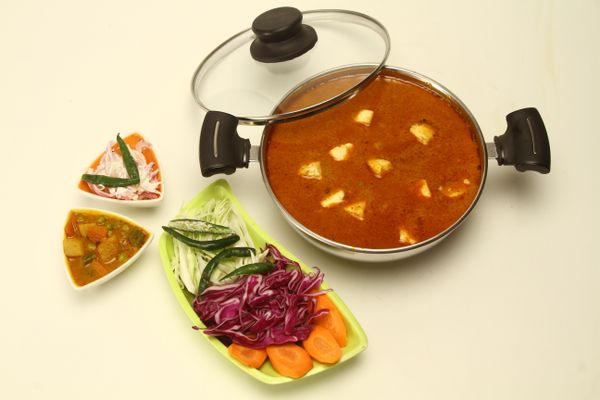
This is why paneer holds its cubes in a boiling gravy and never turns into a puddle. It is not a property of the milk or of any particular skill in the making. It is a direct consequence of how the protein was made to come out of solution.
Which is why it goes rubbery, and how that is managed
The same tightening that keeps the shape is what ruins the texture when it is overdone. Prolonged heat squeezes water out of the protein network and the piece contracts, becoming firm, squeaky and eventually genuinely tough. A cube that was soft when it went in can be unpleasant twenty minutes later.
Almost every traditional handling of paneer is a response to that. It goes into a gravy at the end rather than the beginning. It is fried briefly to set a surface and then added. It is soaked in warm water after frying, which relaxes the contracted surface and puts some moisture back.
Fresh, soft paneer with a higher moisture content is more forgiving than the firm blocks sold for slicing, and much of what people dislike about paneer is really a complaint about a dry, over-pressed one that then spent too long over heat.
It carries flavour rather than providing it
On its own paneer tastes of very little — mildly of milk, faintly sweet, and that’s about the extent of it. This is not a defect; it is the role. It supplies protein and a substantial texture to a plate, and it takes on whatever it is cooked with without contributing anything that would compete.
Because it does not melt, it also doesn’t release fat into the gravy, so the richness in a paneer dish comes from what the cook put there rather than from the cheese itself. That makes it unusually easy to place in a wide range of preparations, from dry spiced pieces on a griddle to a rich ground-nut gravy.
It also makes it a useful indicator. A paneer dish tastes exactly as good as its masala and no better, because there is nothing else in the pan doing any work.
Regional adoption, and the recent flattening
The dishes that are now taken as standard restaurant paneer largely come from the north and the northwest, and they are relatively modern as regional cooking goes. Their spread across the country in the last few decades has been rapid and has more to do with restaurant menus and the need for a reliable vegetarian main than with any older tradition.
That is worth saying plainly, because it is easy to assume anything widespread is ancient. Regions with their own long-established vegetarian traditions had perfectly good sources of substance before paneer arrived on their menus, and in many of them it is a guest rather than a native.
What made it travel is exactly what makes it useful in a kitchen: it keeps for a few days, it’s easy to portion, it survives cooking, and it fits into a gravy designed for something else without any adjustment at all.
Common questions
Why is my homemade paneer crumbly?
Usually too much acid or too much heat at the moment of setting. A vigorous curdling produces coarse, tight curds that will not knit together when pressed. Taking the milk off the boil before the acid goes in and adding it gradually gives softer curds and a smoother block.
Does frying paneer before adding it help?
It does two things. It sets the outer surface so the cubes hold their shape in the gravy, and it adds browning flavour that the cheese cannot supply on its own. The cost is a firmer texture, which is why a soak in warm water afterwards is a common step.
Can paneer be substituted with another cheese?
Not easily, because almost anything else will melt. What you want is another fresh, acid-set cheese with a similar moisture content. A rennet-set cheese in the same dish will collapse into the gravy and change it entirely.
Consumer editor, Wah Taste
Nadia has written about everyday cooking, street food, spice & pantry for most of the last decade and is unreasonably interested in the detail nobody else checks.