Not merely hotter or cooler
Arguments about cooking fuel usually end up being about power — which one gets a pan hot fastest, which one boils a litre of water soonest. That is the least interesting difference. What matters more is the geometry: where on the vessel the heat arrives, and how much of the vessel is involved.
A dish developed on one kind of heat carries assumptions about that geometry, and moving it to another can change the result in ways that look like a recipe problem.
Indian cooking is unusually exposed to this, because so much of it was worked out over an open fire and then transferred to a gas burner within living memory, and is now being transferred again. Each move has quietly rewritten what the vessel receives.
A flame wraps around the vessel
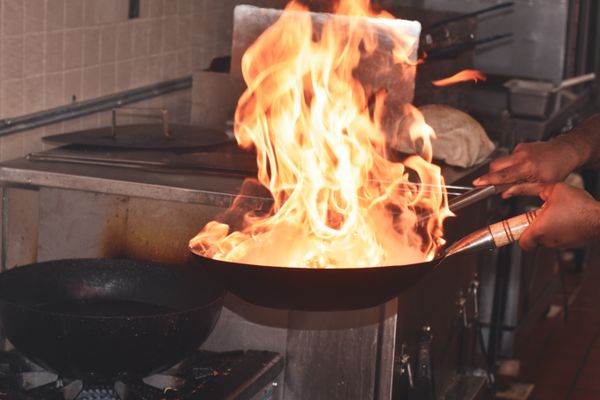
Gas burns above the burner and the hot gases rise around whatever is sitting there, so a flame heats the base and then continues up the sides. On a round-bottomed vessel that is substantial — a large fraction of the total surface is in contact with hot combustion gases, not just the small patch at the bottom.
This is precisely why a kadhai and an open flame suit each other. The curve of the pan sits inside the rising heat, food thrown up the side is still cooking, and the whole vessel is in play. It also gives a real temperature gradient from base to rim, which is a genuine tool.
Flames respond instantly in one direction. Turn the knob and the energy input changes immediately, though the pan itself still has to catch up — a heavy vessel will hold its temperature for a while regardless of what the burner is doing.
Induction heats the metal itself, and only at the base
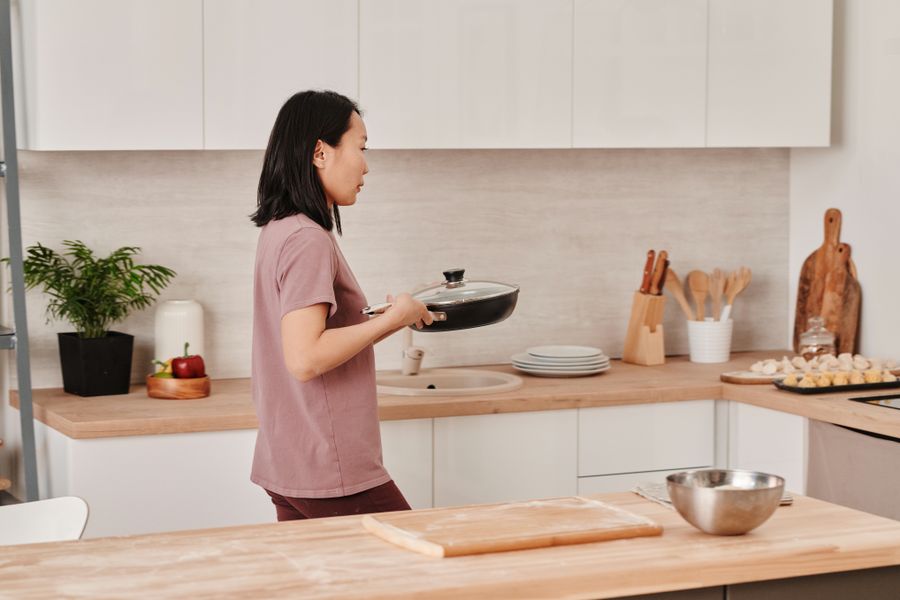
An induction hob doesn’t get hot and then pass heat on. It generates a rapidly changing magnetic field, and that field induces currents inside the base of a suitable pan, which heats up from within. Nothing is transferred through the air, so almost no energy is wasted heating the kitchen.
The consequence is that only the part of the pan sitting flat against the surface is being heated at all. The sides receive nothing directly and are warmed only by conduction from the base and from the food. A vessel with a small contact patch gets a fierce hot spot in the middle and cool walls, which is a completely different environment from a flame.
It also has to be a metal the field can work on, which rules out several materials outright, and the response at the base is essentially instantaneous — faster than gas, in fact, because there is no burner to cool down.
A wood or coal fire adds radiation and something else
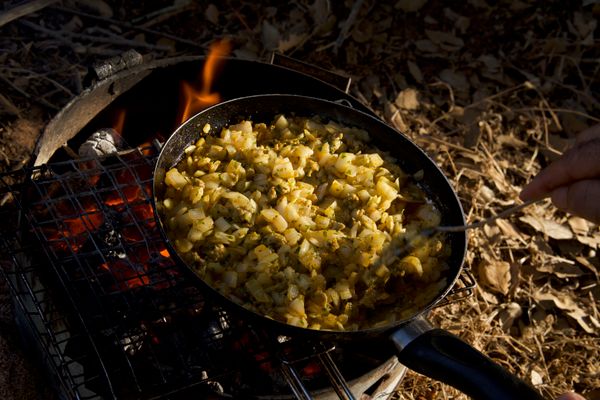
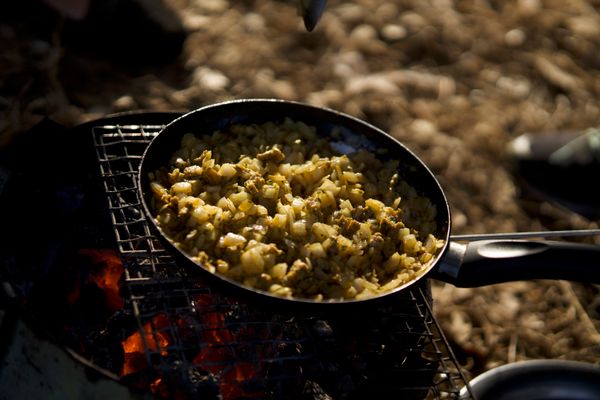
Solid fuel adds a mode of heat transfer the other two barely have: radiation from glowing embers, which travels in straight lines and heats any surface it strikes without needing contact. That is why a pot on a wood fire can be receiving heat over a much broader area than the base.
It also adds smoke, and smoke deposits aromatic compounds on the food. This is not a small effect and it isn’t reproducible on a clean burner — a substantial part of what people mean when they say food cooked on a wood fire tastes different is that it’s genuinely carrying material the fire put there.
What solid fuel does badly is control. A fire cannot be turned down, only fed differently or moved away from, and the whole technique of cooking on one is about managing position and timing rather than adjusting a dial.
What changes when the stove changes
The most common surprise is that a dish that browned nicely on gas comes out paler and wetter on induction, or the reverse. That is usually the wall effect: with heat only at the base, evaporation from the sides of the pan drops and the food spends longer wet.
Timings shift too, and not proportionally. Something that needs a gentle all-round warmth can scorch on a hob that concentrates energy in one flat disc, while something that wants a hard sear at the base may do better than it ever did on a flame.
None of this makes one heat source better. It does mean that adapting a recipe to a different stove is a real adjustment rather than a formality, and that a cook who has moved between them will have quietly rewritten half of what they know without noticing.
Common questions
Why does my round-bottomed pan work badly on induction?
Because only the small area actually touching the glass is being heated. The field does not reach the curved sides, so you get an intense spot at the centre and cool walls, and food at the edge is essentially waiting rather than cooking.
Is gas really more responsive than induction?
At the burner, no — induction changes its output faster. What gas does that induction can’t is heat the sides of the vessel, and that broader contact is often what people are actually noticing when they say a flame feels more responsive.
Can I get a smoky flavour without a wood fire?
Partially. Charring an ingredient directly over a flame, or the traditional method of infusing a covered dish with smoke from a piece of glowing charcoal and a spoonful of fat, both deposit real smoke compounds. It is a narrower effect than cooking over a fire, but it is the same mechanism.
Reporter, Wah Taste
Gautam covers everyday cooking, street food, spice & pantry and the questions readers actually send in and is unreasonably interested in the detail nobody else checks.