A different problem entirely
A home cook makes one dish once, from raw ingredients, in a sequence that ends when it is served. A commercial kitchen has to produce forty different dishes, in any order, at unpredictable intervals, each within a few minutes of being ordered. No amount of skill makes the home sequence fit that requirement.
So the sequence is broken apart. Everything that takes time is done in advance in bulk, and what happens when the order arrives is assembly and finishing. Understanding that single structural fact explains most of the differences people notice and can’t account for.
The base gravy is the central invention
Rather than building a fresh onion and tomato base for every dish, most kitchens make one or a small number of neutral bases in quantity — onions cooked down at length, tomato, sometimes a nut or seed paste, ground smooth and held. That base is common to a large part of the menu, and individual dishes are differentiated from it in the last few minutes with different spice, fat, acid and finishing ingredients.
This gives an unusually smooth, uniform gravy that a home cook rarely achieves, because it has been cooked for far longer than anyone would bother with for a single meal and then blended thoroughly. The characteristic velvety consistency is a consequence of process rather than of an ingredient.
The cost is real too. A base shared across many dishes gives a family resemblance to everything on the menu, and dishes that should taste distinctly different can end up sitting closer together than they would at home.
Components are pre-cooked to the edge of done
Vegetables are par-cooked, meat is often part-cooked or marinated and held, rice is cooked ahead and finished to order, and everything is stopped slightly short of ready. The final minutes bring each component up the last part of the way in the sauce.
This is why textures in restaurant food can be so consistent, and why they are sometimes slightly off — a vegetable that has been cooked, cooled and reheated is not the same as one that went from raw to done in a single pass, however carefully it was handled.
The spicing is broken up the same way. Rather than a sequence of individual spices going into the pan at different moments, a kitchen works from a small number of pre-mixed blends measured out by the spoonful, and the timing that a home cook spreads across half an hour is compressed into the last two minutes. That compression is audible in the food: the layering is shallower, and the top notes are far more prominent than the base ones.
More heat and more fat than a home kitchen uses
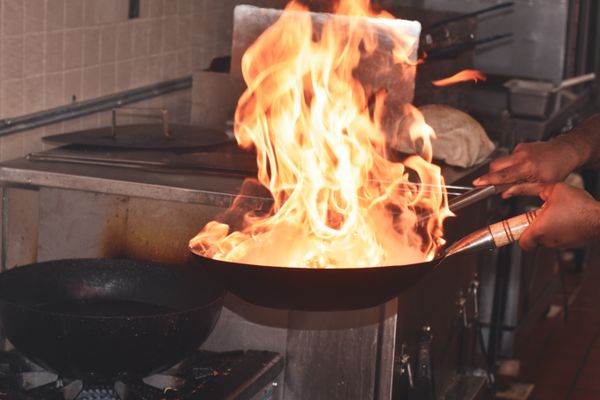
Commercial burners deliver much more energy than domestic ones, which allows a pan to recover its temperature instantly when cold ingredients arrive and lets browning happen in a fraction of the time. A great deal of what looks like technique is simply access to heat that a home kitchen does not have.
Fat is the other lever, and it’s used far more generously than most people cook at home. It carries the fat-soluble aromatics, gives the sheen that reads as quality, coats the mouth so the flavour lasts, and helps a dish survive the trip from pass to table. A home cook reproducing a restaurant dish faithfully is often startled by how much goes in.
Cream, ground nuts and other enrichments do related work, standardising the body of a sauce and smoothing over the variation that fresh ingredients would otherwise introduce.
What this means for cooking at home
The useful lesson is not to imitate the whole system, which makes no sense for one meal. It is that the parts of it that transfer are the ones dealing with time: a base cooked long and in quantity, kept and used across several days, will get you closer to a restaurant gravy than any amount of care applied in a single evening.
It is also worth knowing what the home kitchen wins. Food served the moment it’s finished, components that have never been cooled and reheated, seasoning judged for the people actually eating it, and a dish that does not have to resemble anything else on a menu.
Restaurant food is optimised for consistency, speed and impact at the first mouthful. Home food can be optimised for the third mouthful and the second helping, and those are genuinely different targets rather than different levels of the same one.
Common questions
Can I make a base gravy at home?
Yes, and it is one of the few restaurant practices that genuinely suits a domestic kitchen. Cook onions and tomatoes down at length, blend smooth, and keep or freeze it in portions. Weeknight cooking then starts from a stage that would otherwise have taken most of an hour.
Why does my food never look as glossy?
Usually fat, and secondarily the blending. A restaurant sauce carries more fat suspended through it, and a thoroughly blended base holds that fat as fine droplets rather than letting it separate. Both are things you can copy if you want the look.
Is restaurant food really that much heavier?
Generally, yes, in fat and often in salt and sugar. That isn’t carelessness; it is calibration for a dish eaten once, in a small portion, that has to make an impression immediately. Daily food cooked to the same specification would be exhausting.
Senior writer, Wah Taste
Mateo joined to cover everyday cooking, street food, spice & pantry and stayed for the awkward questions and thinks most subjects are more interesting once you know how they work.